The open-source CompanyOS
Tasklet alternatives: the open‑source one you can own
Most Tasklet alternatives trade one hosted agent product for another, and the part that matters afterwards is whether the agent definitions left with you. Kortix is open source, so they do leave: your agents, their skills, company memory and connectors sit in a git repo you own.
Open source · Any model, your own keys · Connector credentials never enter the machine
default_agent: worker
agents:
  worker:
    permission: allow
    prompt_file: agents/worker.md
    tools: all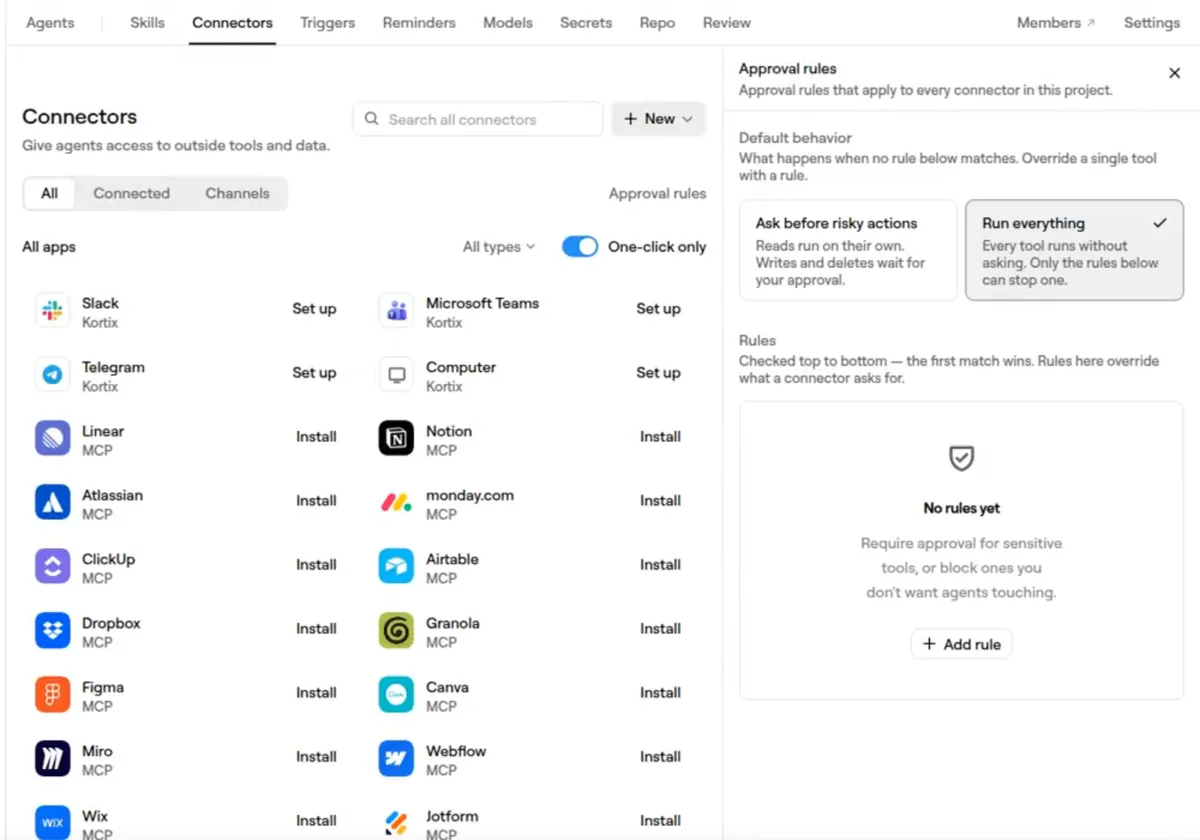
Approval gates you set. Off until you set them.
Screenshot: https://kortix.com/docs/guide#connectors
What you keep after the subscription
Who owns the agent, where it runs, and who can change what it does, each cell taken from the company’s own product or pricing page.
Open source
- Kortix
- Yes. Read it, fork it, audit it.
- Tasklet
- No published open-source version
- Dify
- Yes, self-hosted and open to audit
Hosting
- Kortix
- Yes, cloud, VPC or on-prem
- Tasklet
- No self-hosted install published
- Dify
- Yes, with Docker Compose
Where the agent definitions sit
- Kortix
- In a git repo you own; connector credentials never enter the machine
- Tasklet
- Inside Tasklet’s cloud
- Dify
- Your server, or Dify’s cloud
Models you can run
- Kortix
- Any model, your own keys
- Tasklet
- Anthropic, OpenAI, Google, and open-source labs
- Dify
- OpenAI, Anthropic, Gemini, xAI, Tongyi, or your own keys
Who signs off on an agent’s actions
- Kortix
- Approval gates you set. Off until you set them.
- Tasklet
- You decide what needs your permission
- Dify
- Approval steps are workflow nodes you build
What you pay for
- Kortix
- Credits by usage; members free
- Tasklet
- Pay for work, not seats
- Dify
- Cloud workspace by the year, or self-host
Where it fits
- Kortix
- Teams that want to own the agent layer
- Tasklet
- Teams that want hosted agents and no setup
- Dify
- Teams building LLM apps from parts
Open source, in practice
20,000+
GitHub stars
The repo is the product here, so every setting a hosted dashboard would hide is a file you can open.
- Read it: the platform code, the agent config and the skill files sit in one repository, along with the starter template a new project begins from.
- Fork it: copy
kortix.yamland theagents/folder into a repo of your own, point it at your domain and keep editing it. Nothing in that folder needs a vendor account to open. - Audit it: every tool an agent may call, and every rule about what it may do, is a line you can check before it gets a credential. The source is Kortix on GitHub.
- Start it: follow the self-hosting guide from an empty Linux machine to a running instance, with your own model key.
Before you cancel Tasklet
Prices checked October 2026.
Is Tasklet AI free?
Yes, with limits. Tasklet offers a free tier with limited trial credits and no payment card, so a team can try a few agents before it pays. Paid plans start at $25 a month for casual use and $100 a month for power use, with a $250 tier and any custom amount up to $10,000, billed at the organization level with one shared credit pool. Its pricing page lists the plans.
What is an open-source alternative to Tasklet?
Kortix. Its agents, skills, memory and connectors live in a git repo you own, and you can host it on a server of your own. The setup is files, so a teammate can review an agent change the way they review code.
Can I self-host a Tasklet alternative?
Yes. The source is public, and a self-hosted copy takes the same config as the managed cloud one. Tasklet publishes no self-hosted install, per its site.
What does Tasklet cost?
Plans start at $25 a month for casual use and $100 a month for power use, with a $250 tier and any custom amount up to $10,000, plus one-time credits starting at $25 at a fixed rate of 320 credits per dollar. Starter at $25 carries 10,000 credits, Pro at $100 carries 40,000, and the $250 tier carries 100,000. Billing sits at the organization level and every member draws from one pool. The pricing page lists the current rates and the credit packs.
Start with one agent, keep the repo
Try the cloud today, or pull the source and run it yourself. Start with one job, keep the config in your repo, and add agents as the work grows.
Open source · Any model, your own keys · Connector credentials never enter the machine